Background
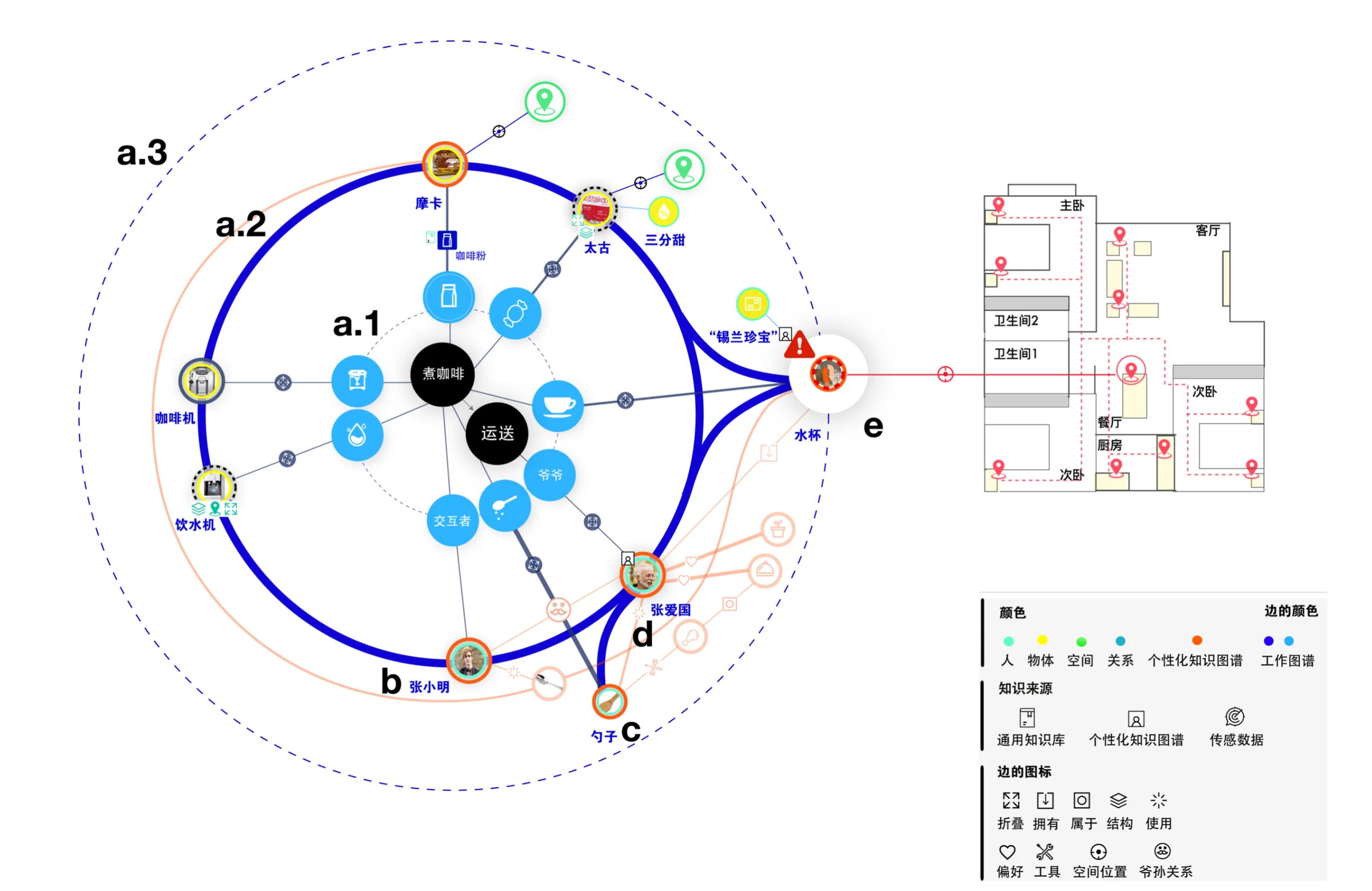
Service robots operating in homes, offices, and care facilities need personalized knowledge graphs that capture environment-specific information about people, objects, spatial layouts, and their relationships. Unlike large-scale general knowledge graphs, these personalized graphs are built from small data in specific settings and require continuous updating — making them prone to missing information, conflicts, and errors. This project introduces working knowledge graphs, task-centric subgraphs grounded from the personalized knowledge graph, as the interface through which users can visually inspect and refine robot knowledge.
Visualization Design
The visualization maps the working knowledge graph onto a spatial layout, encoding node types (people, objects, spaces, relationships) with distinct colors and shapes, and using edge styles to distinguish knowledge sources (general knowledge base, personalized knowledge, and sensor data). A concentric ring layout organizes nodes by their topological distance from the current task, making task-relevant concepts visually prominent while preserving structural context.